Resistance, shifts, and escape routes: towards a critical and emancipatory approach to Mathematics and Language education
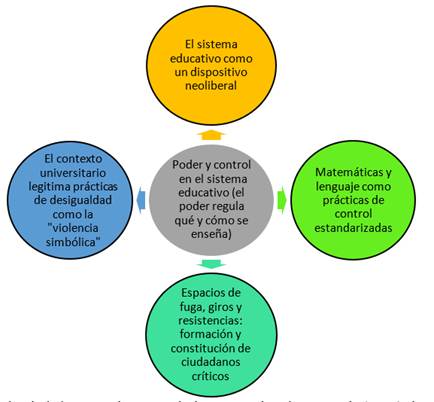
From a theoretical-critical approach, grounded in the contributions of Skovsmose, Popkewitz, Bourdieu, Bernstein, and Foucault, this theoretical review article aims to examine the role of the standardization of language and mathematics teaching in higher education and to explore their potential as emancipatory tools from a critical perspective. It is argued that mechanisms such as curricula and standardized assessments not only regulate the knowledge to be acquired but also discipline students’ bodies and subjectivities, establishing a regime of exclusion that operates under the guise of scientific neutrality. In response to these dynamics-which serve market interests rather than liberating goals-the article proposes a critical and contextualized education that restores the unbinding potential of both disciplines, promoting inclusion, social reflection, and the transformation of the dominant order. Building a critical pedagogy in higher education requires dismantling the neoliberal logic that underpins teaching and creating spaces that enable the formation of reflective individuals capable of challenging power structures and actively contributing to the redefinition of knowledge.
Keywords:
educational policy; educational assessment; social inequality; critical pedagogy; neo-liberalism
 Thumbnail